
Why Understanding Money Is Important For Younger Generations
We may think about money in two different ways – as something we have to work for, or as a human invention that helped us to progress and build the world we have today. Money can be perceived as a flowing blood of our economy, facilitating millions of transactions that occur every single minute. Imagine for a moment that we don’t have this medium of exchange – regardless of its form – How would our world look like?
Money has been with us for thousands of years, in various forms such as common goods, precious metals, paper notes, or credit. We can debate which form came first and what triggered a switch from one form to another. But there is one thing which is hard to argue – money offers power. Those who have money can exert a huge power over those who haven’t. Our history provides us with ample evidence to support this statement. We can all visualize a picture of pharaohs and their slaves, kings and their subjects, or lords and their vassals. The power that wealthy people have over the poor is apparent in these cases. But what about today? What system are we living in? Do we consider ourselves free like pharaohs or kings? Or maybe we are slaves and subjects of somebody or something that we don’t see? Think about it for a moment – does your life feel more like a king’s life or his subject?
This is an important question we should ask ourselves. It allows us to appreciate what we already have but also helps us to think critically when considering what we could have.
Are you a king/queen or a subject?
Who are YOU working for? Do YOU have to work? Could YOU stop working right now if YOU wish so? To be honest, if I answer these questions I won’t really feel like a king (or queen) anymore. Obviously, our responses will vary and strongly depend on one’s perception and personal and financial situation. However, today we don’t look at our society (at least in developed countries) in the category of kings and subjects. This is because of our common belief of being free and having a freedom of choice. But even though we may feel free, still, most of us have to work to support our obligations, needs and wants. But who are we really working for? Let me refer here to an example described by G.Edward Griffin in his excellent work “The Creature from Jekyll Island” that I would recommend you to read.
First, we have to stress on fact that about 97% of our current money is created as a debt when we borrow from a bank. You may not have a debt, but somebody else who pays your salary, for example, may have a debt. When we borrow, we have to pay it back together with an interest. If, for the purpose of a loan, money is created, the obvious question that arises here is – where does the money that we need to pay an interest come from? Well, this extra money has to be created as well. So, the more debt we have, the more money we have to borrow to pay an interest, thus more debt we create and so on. The system as such is not sustainable and its absurdity becomes apparent. However, G.E.Griffin argues that we forget to take one more factor into account – the exchange of value of labour. Here is a short summary of his analysis.
Imagine you took a loan of £100,000 from a bank. Let’s assume your monthly repayment is £800 to cover a principle and £200 to cover an interest. Remember, an interest is a bank’s spendable money (profit), unlike a principle that extinguishes with repayment. As you and your partner struggle to pay the whole monthly amount you decide to take on a job to cover at least the monthly payment of interest. It happened that a bank is offering a part-time job and pays £200/month. You are a successful candidate. Below is an illustration of a loop through which the money will flow.
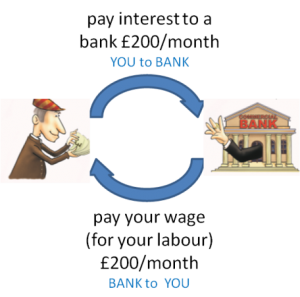
You earn money (by providing your labour and the most precious asset you have – your time) to pay an interest on money that a bank created out of nothing. It is the same money that you earn and spend on interest payment. No matter where you earn your money, and whether the money flows through a large or a small loop, its origin and final destination is a bank. This is because most of it is created in a banking system as a debt.
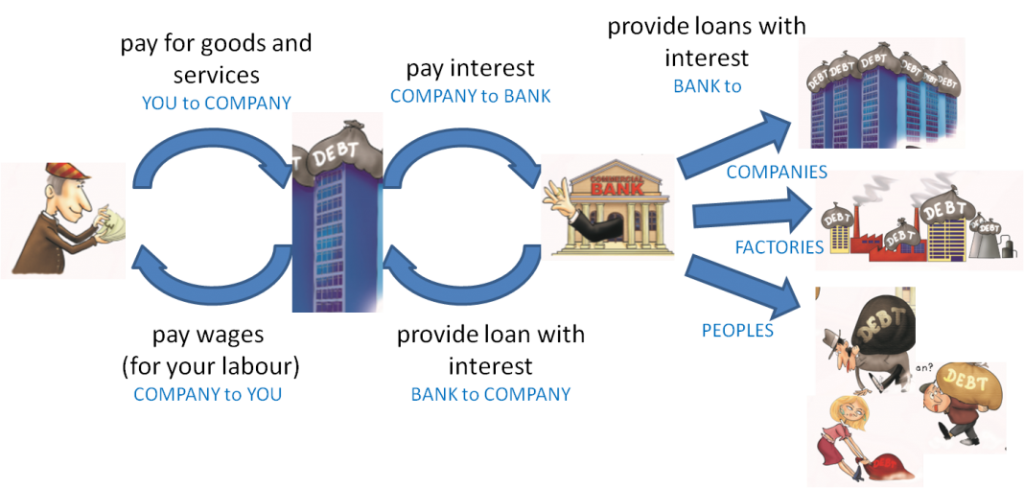
This means, in the long run, all human effort is channelled to pay a bank’s interest. As G.E.Griffin said “…total of this human effort ultimately is for the benefit of those who create fiat money. It is a form of modern serfdom in which the great mass of society works as indentured servants to a ruling class of financial nobility”.
So let’s try to answer the above question again – Are you a king/queen or a subject?
Do you believe that creating money free of debt is an urgent matter for all of us?
And if we get together to give a raise to necessary changes today, who is going to carry on and accomplish this work tomorrow?
If you are looking to educate your children on the link between money and social and environmental problems, and foster the creation of the new, independently and critically thinking generation that will drive positive changes in our society, then why not consider the Money Mystery Book Series. The Money Mystery series goes beyond the typical what is money and how to save type books! The series is a stepping stone for children, early on, to give them a boost in their knowledge of money and its impact on life and society.
If you would like to educate your children about the real nature of money, then discover the Money Mystery Book Series today. The Money Mystery series goes beyond the typical what is money and how to save type books! The series has been developed to raise an awareness of the link between money and social and environmental problems, and foster the creation of the new, independently and critically thinking generation that will drive positive changes in our society.
